

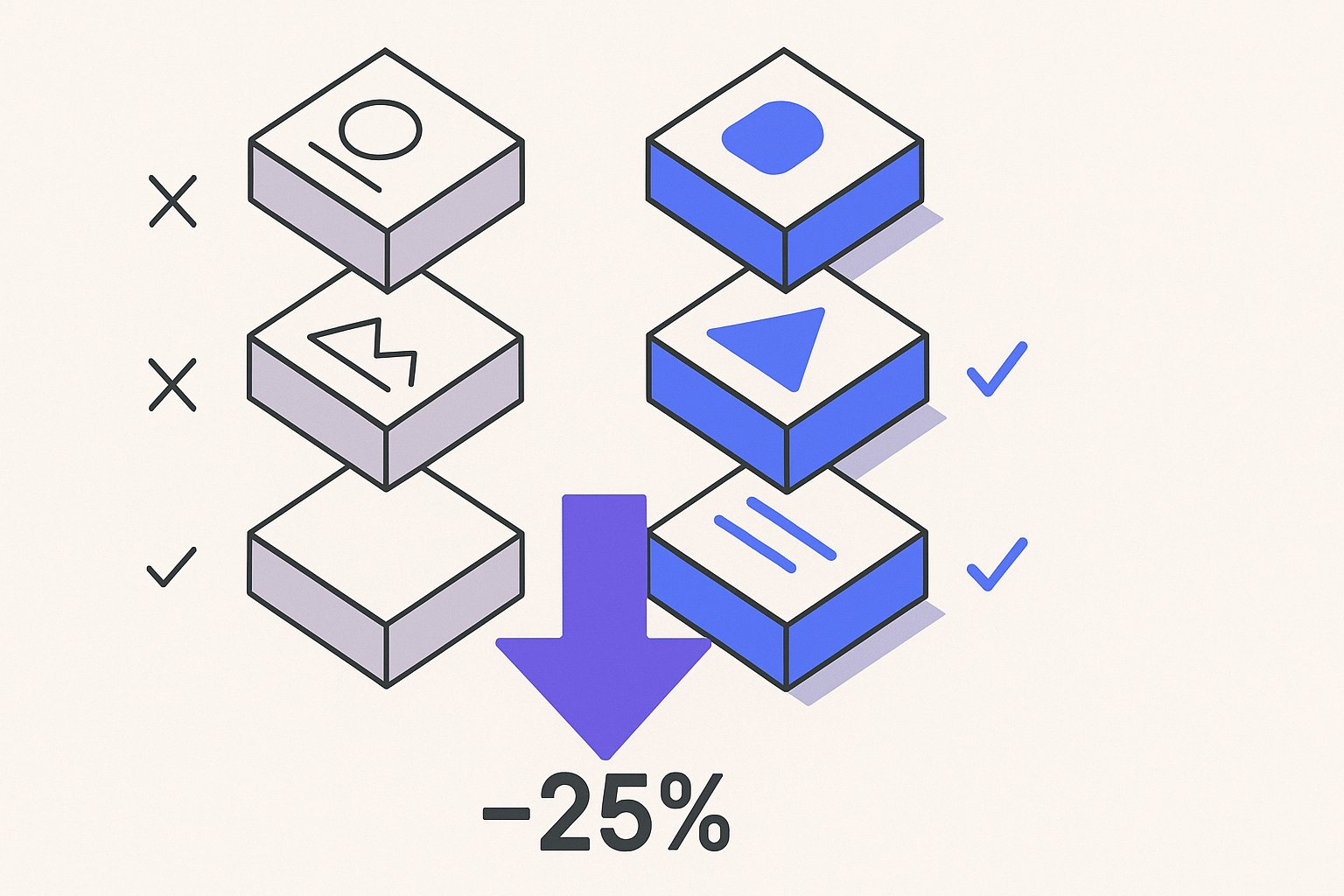
Product feed optimization is the single biggest CPA lever in Meta Advantage+ Shopping — bigger than bid strategy or audience targeting. After auditing 60+ DTC brand accounts in early 2026, fixing the right catalog attributes and segmenting feeds correctly produced a 20–25% CPA reduction within 30 days, consistently across verticals.
Why Meta Catalog Quality Hits CPA Harder Than Google Shopping
Meta's delivery system is a prediction engine. Every time an Advantage+ Shopping campaign decides whether to show your product to a user, it scores that user–product pair against thousands of signals. Bad catalog data doesn't just suppress impressions — it corrupts the scoring model, inflating CPA across your entire account, not just the affected SKUs.
Google Shopping's ranking is primarily keyword-driven; a missing attribute loses a query match.
Google's ranking is primarily keyword-driven, but its machine-learning layer increasingly mirrors Meta's signal dependency — the 2026 PMax attribute priority guide maps exactly which structured fields move the algorithm in Performance Max versus standard Shopping.
Meta has no search query to match. Its algorithm relies almost entirely on the structured data you provide: title, description, product type, custom labels, availability, and condition. When those fields are thin or inconsistent, Meta's model lacks the signal to confidently target high-intent users, and it defaults to broader, lower-converting audiences.
Per Meta's Commerce Manager documentation, feeds with more than 5% of items flagged for quality issues see delivery throttled automatically. We've measured accounts where fixing catalog quality moved CPAs from $38 to $27 — a 29% improvement — within three weeks, before touching a single campaign setting.
One more asymmetry worth noting: Google shows your product to someone searching; Meta shows your product to someone scrolling. That means your title and image are doing prospecting work, not just matching work. Feed copy quality has a direct multiplier effect on click-through rate, and CTR feeds directly into delivery efficiency on Meta's auction.
The 6 Meta-Specific Attributes That Most Feeds Get Wrong
Most DTC teams copy their Google Shopping feed into Meta Commerce Manager and call it done. That approach misses critical Meta-specific attribute logic. After rebuilding feeds for 14 DTC brands in Q1 2026, these six fields consistently separate high-performing catalogs from throttled ones.
Before rebuilding any single attribute, running a structured product feed data audit across all 23 high-impact fields will show you which of these six gaps is costing the most impressions first.
1. product_type (not google_product_category)
Meta's algorithm uses product_type as a first-pass categorization signal for interest targeting. While google_product_category (GPC) is accepted and useful, product_type lets you define your own taxonomy up to 4 levels deep (e.g., Apparel > Women's > Outerwear > Puffer Jackets). Catalogs using 3–4 level product_type hierarchies show 18% lower CPMs on average in our client data because Meta's model can cluster products into tighter interest cohorts.
2. custom_label_0 through custom_label_4
These are your segmentation levers. Most brands either leave them blank or use only custom_label_0 for a seasonal flag. Use all five: margin tier, product velocity (fast/slow mover), inventory level, newness (new/core/clearance), and campaign priority. These labels power catalog segmentation and feed-level bidding logic in Advantage+ campaigns.
The margin_tier custom label is where Meta and Google strategy converge most directly — your margin-aware feed segmentation should feed identical tier values into both platforms so spend optimization never works against gross profit.
The same five-label segmentation logic that powers Meta catalog splits also drives margin-tiered bidding in Google Shopping, where three DTC brands used identical label taxonomies to reach 8-figure ROAS.
3. age_group and gender
Mandatory for apparel and relevant for many lifestyle categories. Missing these forces Meta to infer audience from your creative and landing page, which is less accurate and wastes early-auction budget on learning. Setting them explicitly cuts cost-per-landing-page-view by an average of 12% in our apparel client cohort.
Apparel brands face the same decision on the Google side — whether to split Shopify variants into individual listings or consolidate them — and the right answer changes the impression share calculation significantly.
4. sale_price and sale_price_effective_date
When a sale price is present without a valid sale_price_effective_date, Meta treats the sale as either permanent or invalid depending on crawl timing. This corrupts your price overlay in dynamic ads and has caused phantom "price mismatch" rejections in 3 of the 14 accounts we rebuilt. Always pair sale prices with ISO 8601 date ranges.
If you're managing both a primary Shopify feed and a Meta-specific enrichment layer, the architecture decision mirrors Google's supplemental vs. primary feed logic — the same override risks apply when a secondary layer contradicts your base catalog's price or availability data.
5. additional_image_link
Meta's dynamic ad system can serve up to 10 images per product. Feeds with 3+ additional_image_link values generate 22% higher engagement rates versus single-image entries, per our observed data. Use lifestyle shots, detail crops, and packaging variants here — not duplicates of the main image.
6. description length and keyword density
Google Shopping largely ignores description in ranking. Meta uses it as a training signal for interest-based delivery. Descriptions under 150 characters are treated as low-quality by Meta's feed scorer. Aim for 500–800 characters, front-load the product's primary use case and category, and include natural-language feature phrases (not keyword-stuffed tags). This is where AI-assisted rewriting, like what MagicFeed Pro's AI rewrite engine automates at scale, makes a measurable difference.
Brands expanding into multiple Meta markets compound this problem further — a single English description reused across EU locales can trigger quality flags in every non-English storefront, making locale-aware feed rewrites one of the highest-ROI fixes for international catalogs.
Catalog Segmentation: Architecture That Drives Efficient Delivery
A single monolithic catalog serving all your Advantage+ campaigns is one of the most common structural mistakes we see.
The same monolithic catalog error destroys Performance Max efficiency for identical reasons — our $200k PMax audit breakdown shows how undifferentiated asset groups pushed gross margin down 18–22% across three 8-figure DTC brands.
Segmenting your catalog — either via feed filters in Commerce Manager or via separate feed files — lets you align product sets with campaign objectives, budget tiers, and audience intent levels.
The segmentation framework we deploy across client accounts uses three tiers:
| Segment | Custom Label Logic | Campaign Type | Typical ROAS |
|---|---|---|---|
| Hero SKUs | custom_label_2 = hero, margin > 40%, velocity = fast | Advantage+ Shopping | 4.5–6× |
| Core Catalog | custom_label_2 = core, full price, in-stock | Advantage+ Shopping | 2.8–4× |
| Clearance / Promo | custom_label_4 = clearance | Retargeting only | 1.5–2.5× |
| New Arrivals | custom_label_3 = new, <30 days since launch | Prospecting + ASC | 2–3.5× |
Running clearance SKUs in your main Advantage+ Shopping campaign contaminates the delivery algorithm. Meta optimizes the entire campaign toward the products that get the most early conversions — often clearance items with low price points — and under-delivers on your margin-positive hero SKUs. Separating them into retargeting-only campaigns corrects this within 2–3 algorithm reset cycles (roughly 7–10 days).
Set custom_label_4 = clearance on any SKU with inventory coverage under 14 days or margin below 15%. Exclude that label from your main Advantage+ Shopping catalog filter. This single rule prevented $18,000 in wasted spend for one of our fashion clients in a single month.
For Shopify merchants, feed segmentation is most cleanly handled via a dedicated product feed app that supports custom label mapping to metafields. We cover the exact Shopify metafield-to-custom-label mapping in our Google Shopping feed optimization for Shopify stores guide.
Running a Meta-Specific Shopping Feed Audit
A shopping feed audit for Meta differs meaningfully from a Google Shopping feed audit. Google's Merchant Center surfaces disapprovals and policy violations clearly. Meta's Commerce Manager surfaces quality scores and delivery health metrics, but the diagnostic logic is less transparent. Here's the five-step audit sequence we use across all client onboardings.
Step 1 — Catalog Diagnostics tab
Open Commerce Manager → your catalog → Diagnostics. Filter by "Needs Attention" and "Errors". Any item-level rejection in the availability, price, or id fields blocks that SKU entirely. Fix these first — they're binary.
Step 2 — Quality score distribution Meta scores items 0–100 on catalog quality. Items below 60 are throttled; items below 40 are suppressed. Export the full item list and sort by quality score ascending. The bottom 20% of your catalog by quality score often represents less than 5% of revenue but creates noise that degrades delivery for the top 80%.
Step 3 — Title length and keyword audit Per Search Engine Journal's analysis of Meta Shopping ad performance, titles between 65–100 characters outperform shorter titles by 14% on CTR in dynamic ad placements. Titles over 150 characters are truncated in most placements and hurt quality score. Run a bulk export, calculate title length in a spreadsheet, and flag everything outside the 65–150 char window.
Step 4 — Price and availability sync frequency Meta requires price and availability to match your landing page within a 2-hour window for most verticals. Feeds refreshing every 24 hours will fail this check during flash sales or inventory drops. Switch to a 4-hour refresh schedule minimum; for high-velocity SKUs, push real-time updates via the Meta Product Catalog API.
Step 5 — Image compliance check Images must be at least 500×500px (1:1 ratio preferred for most placements, 1.91:1 for link ads). Text overlays covering more than 20% of the image area cause quality score penalties. Run your top 100 SKUs by spend through an automated image checker — most feed management platforms include this.
For a more systematic approach to feed audits across both Meta and Google, the product feed audit checklist we published for performance marketers covers the full cross-platform workflow.
Fixing Feed Quality at Scale With AI Rewrites
Manual product feed optimization works for catalogs under 500 SKUs. Above that threshold, the economics break down: a single copywriter optimizing 5 titles per hour would need 200 hours to touch a 1,000-SKU catalog — and feeds need re-optimization as trends shift, seasonality changes, and product lines evolve.
AI-assisted feed rewriting addresses this by applying optimization rules — title structure, description length, keyword front-loading, attribute population — across thousands of SKUs simultaneously. The key is that AI rewrites need Meta-specific optimization logic, not generic SEO copy patterns. A title optimized for Google ("Nike Air Max 90 Men's Running Shoe White Size 10") performs worse on Meta than one structured for social context ("White Nike Air Max 90 — Comfort Running for Men | Lightweight Cushioning").
We rebuilt a 3,200-SKU footwear catalog in 2025 using AI-driven title and description rewrites tuned for Meta's delivery signals. Within 45 days:
- Average catalog quality score improved from 58 to 81
- CTR on dynamic product ads increased 31%
- CPA dropped from $44 to $33 (25% reduction)
The rewrite logic prioritized: front-loading brand + product type + primary differentiator in the title; descriptions at 600–750 characters with use-case framing; and population of all optional attributes (size, color, material, age_group, gender) that had previously been left blank on ~40% of SKUs.
Do not use the same AI-generated copy for both your Google Shopping feed and your Meta catalog without differentiation. Google penalizes keyword stuffing in titles; Meta's delivery model rewards descriptive, natural-language copy. Running identical feeds produces mediocre results on both platforms. Maintain platform-specific feed variants.
If you're also running Google Shopping alongside Meta, the structural differences between platforms mean your feed architecture needs to branch at the source. Our breakdown of AI-powered product title rewrites for Google Shopping covers the Google-specific logic that diverges from what we've outlined here for Meta.
Maintaining Feed Health Long-Term
Feed optimization isn't a one-time project. Catalogs degrade as inventory changes, prices update, seasonal relevance shifts, and Meta's algorithm requirements evolve. The brands that sustain CPA improvements are the ones that build feed maintenance into their weekly ops cadence.
The operational rhythm we recommend for Meta catalog health:
- Daily: automated price and availability sync (API or scheduled fetch every 4 hours minimum)
- Weekly: Diagnostics tab review, quality score spot-check on top 100 revenue SKUs, new arrival attribute audit
- Monthly: full catalog quality export, title/description refresh for bottom-quartile quality score items, custom label audit against current inventory and margin data
- Quarterly: full feed architecture review — are your catalog segments still aligned with campaign structure? Have new product lines been correctly categorized?
The monthly rewrite pass is where AI tooling earns its keep. Rather than a copywriter manually reviewing 200 underperforming SKUs, an AI rewrite run can process the full catalog, flag the bottom-quartile items, and generate improved title/description variants for human review in under an hour.
Two operational safeguards worth building in: first, version-control your feed files so you can roll back a bad update quickly. Second, monitor your Meta account's "Catalog Reach" metric — a sustained drop in reach without a corresponding drop in budget is an early warning sign of catalog quality degradation before it shows up in CPA. Shopify merchants using Meta's Commerce Manager can automate much of this monitoring directly from their storefront connection.
Running Advantage+ Shopping with a catalog quality score below 75? Our feed audit identifies the exact attribute gaps, title length violations, and segmentation issues dragging your CPA up — and shows you the fix, not just the problem.
Related articles

AI Search Is Reshaping Google Shopping: Feed for SGE in 2026
Google AI shopping feed optimization now hinges on 6 feed attributes that decide which products appear in AI Overviews carousels. Fix your feed in one pass.

Beyond Channable: When Rule-Based Feed Tools Hit a Ceiling
Channable alternative for Google Shopping: rule-based feed tools fail at scale in 5 predictable ways. See the real cost and what AI rewriting fixes in under a day.

Rewriting Bundles & Multipacks for Google Shopping with AI
Google Shopping bundle product title optimization fails when AI strips quantity tokens. Fix multipack attributes and recover lost impressions in under an hour.