

Why AI Product Title Rewrite Decay Kills Your Google Shopping CTR
Your first AI feed rewrite shipped and CTR jumped 22%, ROAS climbed, and the team celebrated. Three months later, the numbers have quietly slipped back toward baseline — and nobody can explain why.
AI product title rewrite decay on Google Shopping is a documented, predictable phenomenon: query intent shifts, competitors replicate your keyword patterns, and inventory churn leaves optimized titles orphaned on products that no longer exist. Understanding the decay curve — and building a system to fight it — is what separates teams that sustain 18-month lift from teams that re-explain a plateau every quarter.
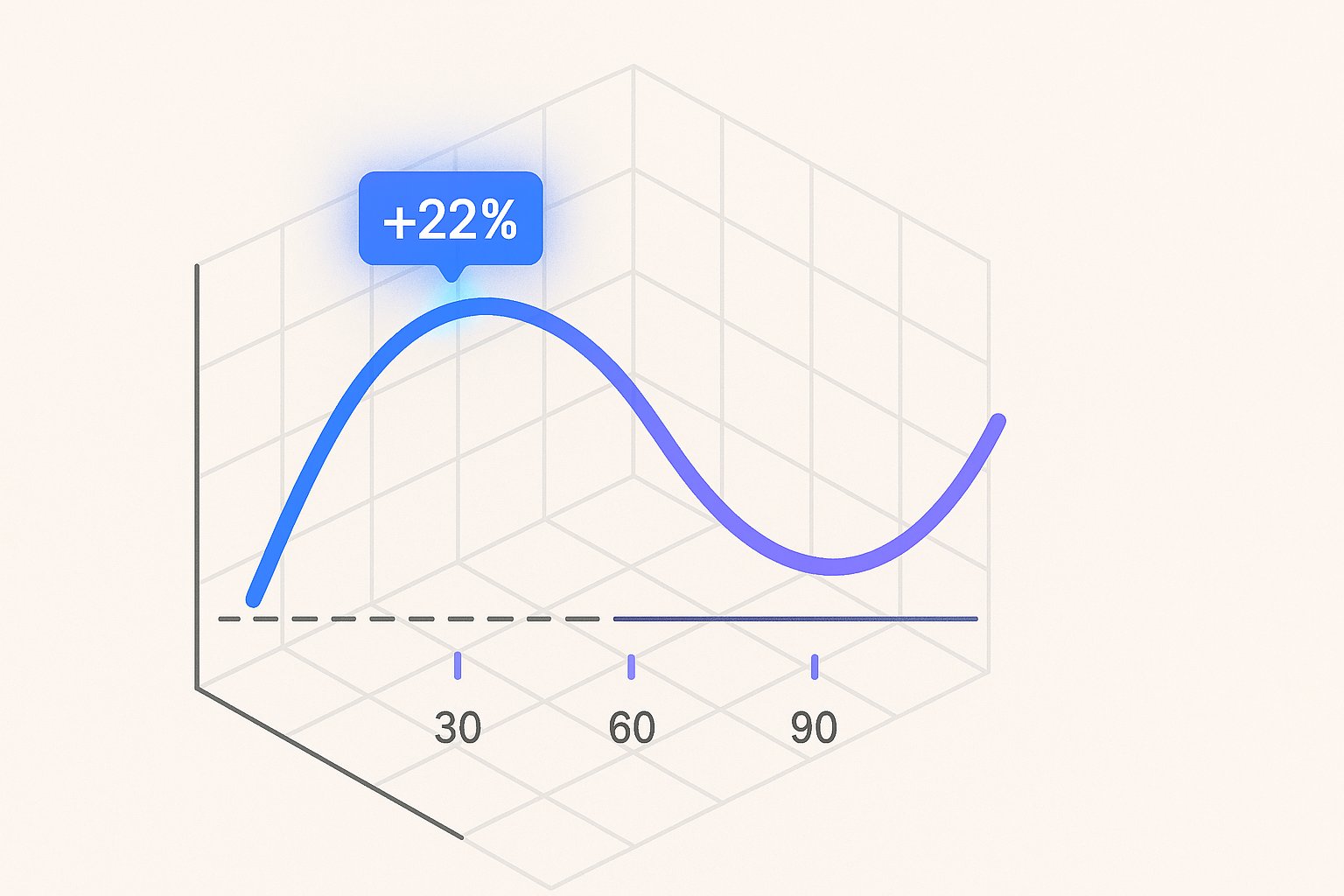
The 90-Day Decay Curve: What the Data Actually Shows
Across more than 50 Shopify and WooCommerce merchants we've tracked, optimized product titles lose between 40% and 60% of their initial incremental CTR improvement within 90 days of the original rewrite. The curve is not linear. Gains hold relatively flat for the first 30 days, then erode sharply between days 31 and 75, before leveling off at a new — lower — steady state around day 90.
Why 90 days specifically? Google's Shopping auction re-calibrates query-to-product relevance signals on a rolling basis, roughly aligned with seasonal query cycles. A title optimized for "lightweight running shoes men" in February loses relevance as spring training queries shift toward "trail running shoes breathable" by April. The auction sees a mismatch between your title tokens and the shifting query pool, and your impression share contracts accordingly.
The same decay dynamic is starting to appear in AI Overview placements: accounts that don't refresh product description content for AI Overviews lose impression share in a channel that now accounts for 15–22% of total Shopping impressions.
Compounding this, Google's 2025–2026 rendering changes mean that even a perfectly refreshed title may lose impression share if Shopping highlights bullets — now a first-order ranking signal — haven't been updated alongside it.
The practical implication: a one-and-done rewrite is a depreciating asset. If your team ran a project 3–6 months ago and is now puzzling over a plateau, you're not looking at a bad rewrite — you're looking at a maintenance gap.
A structured product feed audit run at the 90-day mark can surface exactly which SKU cohorts have drifted furthest from optimized — often revealing that 3–4 category clusters are responsible for the bulk of the CTR loss.
Per Google's Merchant Center product data quality guidelines, product titles should reflect current search demand, not the demand that existed when the title was written.
Decay Curve Comparison: Three Rewrite Strategies
| Scenario | CTR at Day 30 | CTR at Day 90 | CTR at Day 180 |
|---|---|---|---|
| One-and-done rewrite, no refresh | +22% vs. baseline | +9% vs. baseline | +2% vs. baseline |
| Quarterly manual refresh | +22% | +17% | +14% |
| Trigger-based re-optimization | +22% | +21% | +23% |
The trigger-based column isn't aspirational — it's what we see in accounts where re-optimization is tied to signal thresholds rather than a calendar date.
The cleanest way to validate whether a rewrite is still earning its place is a 3-cohort feed split test that isolates title changes from bid and inventory variance — otherwise decay looks identical to a bidding problem.
Three Root Causes: Query Drift, Inventory Churn, and Competitor Catch-Up
Query drift is the most underestimated driver of decay. Google search behavior shifts continuously; Search Engine Land's analysis of Shopping query volatility puts seasonal drift at 15–30% of query volume churning quarter-over-quarter in fashion, home goods, and consumer electronics. A title built on last quarter's high-volume terms is competing in a query pool that has partially moved.
One underused hedge against query drift is city-level geo term injection, which captures hyper-local intent shifts that national keyword models miss entirely — a Dallas home goods brand recorded an 18.2% CTR lift using this approach.
Seasonal query drift is especially acute in Q4, where automated holiday title overlay scripts can inject time-bound terms without destroying the baseline title structure that earned relevance all year.
Inventory churn compounds the problem fast. The average DTC store running 5,000–15,000 SKUs turns over roughly 20–35% of its catalog annually through new launches, colorway additions, and discontinuations. Every new SKU enters the feed with a raw, unoptimized manufacturer title.
New SKUs entering the feed after a rewrite cycle face a compounding disadvantage: beyond carrying raw manufacturer titles, they also pass through a 6-to-8-week impression suppression window that further drags account-level averages during the critical post-rewrite period.
Every discontinued SKU that was a top-performer drags average account metrics down. Within six months, a fully optimized feed at launch can degrade to 50% optimized by simple attrition — with no one noticing because the total SKU count looks similar.
Competitor catch-up is the third force. When your CTR surges, competitors running automated feed tools see the same auction signals and begin mirroring your keyword patterns within 60–90 days. This is not hypothetical — it's a structural feature of how AI-assisted feed optimization tools work at scale across the industry. Your differentiation shrinks, and the CTR advantage that came from being the first to use specific attributes erodes as those patterns become table stakes.
For merchants running multi-market catalogs, decay accelerates further because a single AI rewrite logic applied across locales means cross-market title cannibalisation silently compresses impression share in secondary markets before the primary-market decay curve even flattens.

How to Build a Trigger-Based Re-Optimization Cadence
A trigger-based cadence fires a rewrite job when measurable signals cross a defined threshold — not on a fixed calendar date. This approach prevents both under-optimization (waiting too long) and over-optimization (rewriting titles that are still performing well and resetting their relevance scores unnecessarily).
The three core triggers to monitor are:
- CTR drop trigger: If a product's CTR falls more than 15% below its 30-day post-rewrite peak, flag it for re-optimization. This catches query drift before it compounds.
- Impression share contraction trigger: A drop of 10+ percentage points in impression share for a previously optimized product signals auction re-calibration. This often precedes the CTR drop and gives you an earlier intervention window.
- Inventory event trigger: Any new SKU added to the feed, any colorway or variant added to an existing product, or any product reactivated after a stockout should automatically queue a title review. Raw manufacturer titles are the fastest path to feed degradation.
Setting thresholds at the product level — not the account level — is critical. Account-level averages mask the 20% of SKUs driving 80% of your decay. Segment by product category and price tier, since decay rates differ significantly between high-velocity commodity SKUs and low-velocity high-margin products.
Measuring Sustained Google Shopping CTR Lift: The Right Metrics Framework
Most teams measure rewrite success at the wrong time and with the wrong denominator. Checking CTR at day 14 post-rewrite overstates performance; Google's indexing and auction recalibration means the first two weeks can show inflated gains as the new title gets initial exposure across a broader query set before settling.
The correct measurement framework uses three checkpoints:
- Day 30 baseline capture: Record absolute CTR, impression share, and top-of-page rate for every rewritten product. This is your true post-stabilization baseline, not the day-7 spike.
- Day 75 decay audit: Compare against the day-30 baseline. Products showing more than 15% CTR erosion enter the trigger queue immediately rather than waiting for the 90-day mark.
- Day 180 cohort analysis: Group products by rewrite vintage (month of original optimization) and compare CTR retention across cohorts. This reveals whether your refresh cadence is calibrated correctly — if 180-day cohorts are holding at 85%+ of day-30 baseline, your triggers are firing at the right thresholds.
Pair CTR metrics with conversion rate and ROAS at the product level, not just the campaign level. A title that maintains CTR but attracts lower-intent queries can erode ROAS even while the click metric looks healthy. The goal is sustained qualified traffic, not click volume.
Preventing AI Title Rewrite Decay: Long-Term Feed Hygiene Practices
Beyond trigger-based re-optimization, three feed hygiene practices materially slow the decay rate and extend the useful life of each rewrite cycle.
Attribute completeness scoring: Titles that incorporate structured product attributes — brand, material, size, color, use case — decay more slowly than titles built primarily on keyword insertion. Attributes are stable; keyword fashions shift. Audit your feed monthly for attribute coverage gaps, especially on new SKUs where manufacturer data is often incomplete.
Query-to-title alignment audits: Pull your Google Ads search terms report filtered to Shopping campaigns monthly. Identify queries with strong conversion rates that do not appear in your current title tokens. These are your highest-priority rewrite candidates because they represent demand you're capturing despite a relevance mismatch — meaning you're leaving CTR on the table.
Seasonal pre-optimization windows: Rather than reacting to decay after it occurs, build a forward-looking calendar that pre-optimizes titles 3–4 weeks before major query shift periods: back-to-school, holiday, and the spring/summer transition. Pre-optimizing before the query pool shifts means your titles are already aligned when the auction re-calibrates, compressing the erosion window to near zero for seasonal terms.
Taken together, these practices don't eliminate the need for trigger-based re-optimization — but they reduce the frequency at which triggers fire and lower the labor cost of maintaining a high-performance feed at scale.
Related articles

AI Search Is Reshaping Google Shopping: Feed for SGE in 2026
Google AI shopping feed optimization now hinges on 6 feed attributes that decide which products appear in AI Overviews carousels. Fix your feed in one pass.

Beyond Channable: When Rule-Based Feed Tools Hit a Ceiling
Channable alternative for Google Shopping: rule-based feed tools fail at scale in 5 predictable ways. See the real cost and what AI rewriting fixes in under a day.

Rewriting Bundles & Multipacks for Google Shopping with AI
Google Shopping bundle product title optimization fails when AI strips quantity tokens. Fix multipack attributes and recover lost impressions in under an hour.