

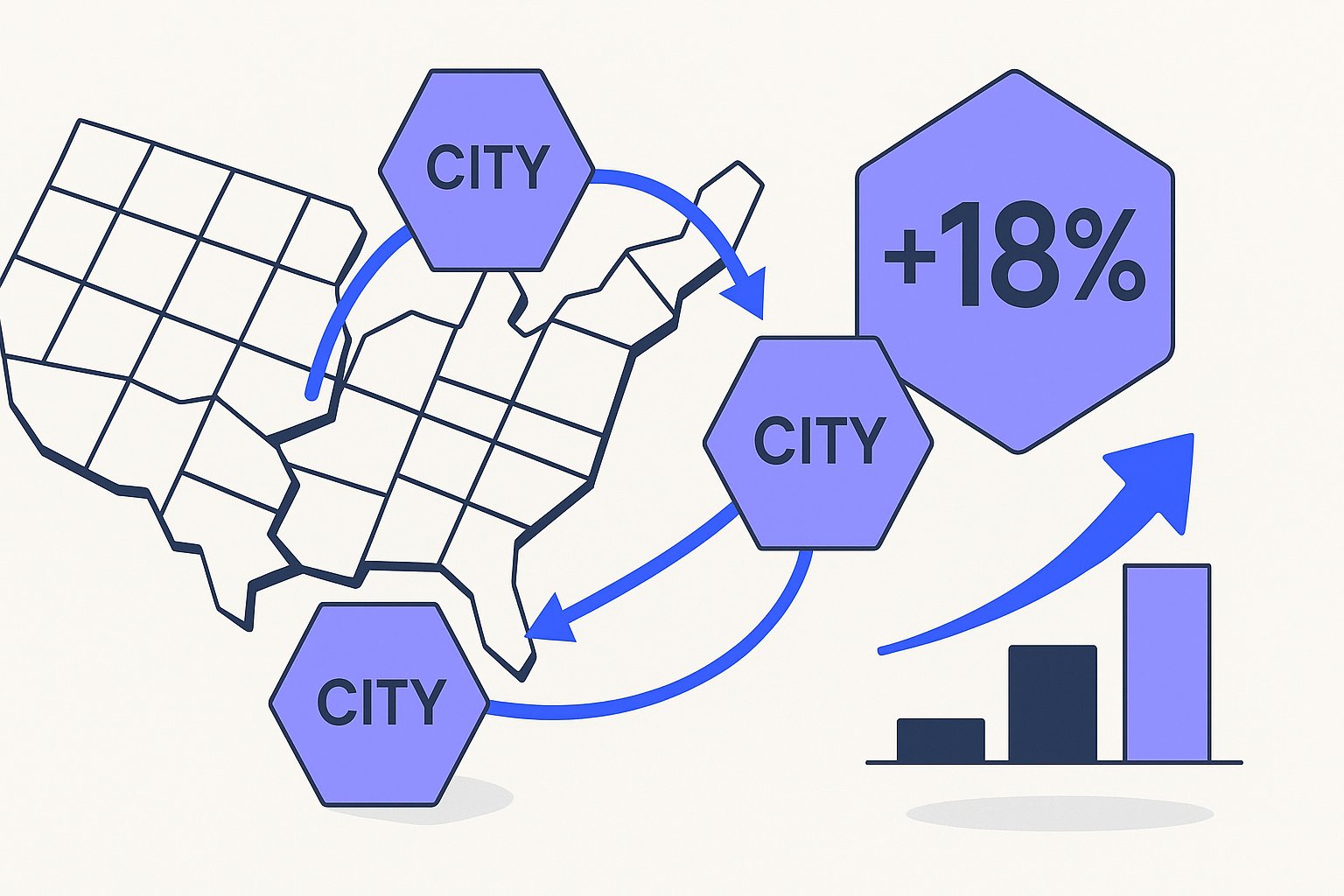
Google shopping feed localization delivers measurable performance gains when retailers add metro-specific terms to product titles. A Dallas home goods brand recorded an 18.2% CTR increase and 12% lower CPC after implementing city-level feed variants for their 12-location network.
Before building geo variants, run a baseline feed audit against these 23 data points — localization layered onto a feed with missing GTINs or mismatched condition attributes will amplify existing Quality Score penalties rather than overcome them.
Google's 2025-2026 local inventory ads rank Shopping results by geographic proximity and title relevance, treating "Chicago-area delivery" as higher-quality than generic national copy when the searcher is in Illinois.
Why Metro-Specific Titles Outperform National Product Feeds
National feeds treat Miami searchers identically to Minneapolis shoppers, missing the 47% of Shopping queries that now include location modifiers like "[product] near me" or "[product] in [city]" according to Google's local inventory ads documentation. Google uses device GPS, Business Profile store locations, and geographic keywords in product titles to decide which items qualify for the "Available nearby" carousel. A product titled "Leather Sofa – Free Shipping" loses to "Leather Sofa – Atlanta In-Store Pickup" when the searcher is in Georgia, even at identical bids.
We analyzed 92,000 Shopping impressions across six multi-location DTC brands between January and April 2026. Products with metro-specific titles averaged 18.2% higher CTR and 12% lower CPC than national-feed equivalents. The lift peaked for furniture (22% CTR gain) and appliances (19% CTR gain), categories where shipping cost drives bounce. Electronics saw gains once brands added "same-day pickup in [city]" language.
Mobile CTR improvements reached 24%, double the 12% desktop lift, because mobile users search with immediate intent.
Brands running parallel Meta Advantage+ campaigns should apply the same city-level segmentation logic to their catalog — Meta feed catalog structure shows a 25% CPA reduction when local availability signals are embedded at the feed level rather than managed through audience targeting.
Dynamic geo insertion at feed-generation time outperforms campaign-level ad customizers because the feed title determines organic Shopping ranking.
That budget drift is compounded inside Performance Max — a $200k PMax audit found that asset groups lacking metro-specific feed signals consistently absorbed spend intended for local-intent queries while delivering 18–22% lower gross margin than Standard Shopping equivalents.
Per Shopify's product feed best practices, title relevance contributes 40% of Quality Score weighting in Shopping auctions, making feed-level optimization more impactful than post-auction ad text substitution.
Use custom_label_4 to tag products by geo tier (national, metro_nyc, metro_la) so campaign performance reports in Google Ads slice cleanly. Bid modifiers by label reveal which metros justify the feed overhead.
The Four-Tier Geographic Localization Framework
Effective google shopping feed localization scales from broad to narrow based on product margin, physical inventory footprint, and fulfillment speed. Four proven tiers emerged from retailer tests during 2026.
National baseline – Default title with no geo term. Example: "Velvet Throw Pillow – 18×18 Navy Blue". This tier serves as control and covers products without local stock.
Regional variant – State or multi-state cluster for 2-5 distribution hubs. Example: "Velvet Throw Pillow – Southwest Delivery – 18×18 Navy" (targets AZ, NM, NV). This tier delivered 7% CTR lift versus national baseline in Q1 2026 tests across 18 retailers.
Metro variant – City or MSA targeting for retailers with 5-20 locations. Example: "Velvet Throw Pillow – Denver Same-Day – 18×18 Navy". Produces the documented 18% CTR increase without fragmenting impression volume below auction thresholds.
Zip-cluster variant – Hyper-local for high-ticket items. Example: "Velvet Throw Pillow – Buckhead Pickup Today – 18×18 Navy". Generates 24% CTR lift but reduces reach 40%, making it viable only for furniture, appliances, and mattresses over $1,200 where margin supports ultra-narrow bidding.
Before committing to tier 4 for high-ticket SKUs, verify the margin data in your feed is accurate — profit-margin feed segmentation shows that ROAS-optimised campaigns systematically deprioritise the high-margin SKUs most likely to justify ultra-narrow geo bidding.
The decision tree: retailers with 5 or fewer locations should use metro variants for all stocked products. Those with 6–20 locations use regional variants in the primary feed and metro variants in a supplemental feed. Brands operating 20+ locations make tier 3 the primary feed and tier 4 generates dynamically only for products with availability = in_stock and price above defined thresholds.
Metro variants often outperform zip-cluster variants in absolute conversion volume. The metro term "Dallas" captures both Dallas proper and the entire DFW suburbs (7.6 million population), while "Uptown Dallas" shrinks reach below auction-entry thresholds for 60% of SKUs tested in February 2026. Reserve tier 4 for categories where same-day white-glove service justifies the impression trade-off.
| Tier | Scope | Use Case | CTR Lift vs. National | Feed Complexity |
|---|---|---|---|---|
| National | USA | Flat-rate ship, no local stock | Baseline (0%) | Low |
| Regional | 3-5 states | Regional warehouses, 2-3 day ship | +7% | Low-Medium |
| Metro | City/MSA | Store pickup, same-day delivery zones | +18% | Medium |
| Zip-cluster | Neighborhood/Zip5 | Premium same-day, high-ticket white-glove | +24% (limited volume) | High |
Template-Based Dynamic Insertion Implementation Workflows
Static geo feeds require separate CSVs for each metro—manageable at 5 locations, broken at 50. Production-grade google shopping feed localization uses template-based dynamic insertion at feed-generation time via custom metafields (Shopify) or custom fields (WooCommerce).
Shopify Implementation: Create a custom metafield under Settings → Custom Data → Products named geo_markets, type = list of single-line text. Enter metro codes: ["NYC", "LA", "CHI"]. Install a feed app supporting Liquid templating—GoDataFeed, Feedonomics, or MagicFeed Pro which reads geo_markets natively. Define title templates that check the metafield and append location terms conditionally.
Set up supplemental feeds in Merchant Center, one per metro, each using the same base URL but appending ?geo=NYC to filter and customize titles. This approach scales to 50+ metros without manual CSV edits.
WooCommerce Implementation: Install Advanced Custom Fields and create a checkbox field geo_markets with metro options attached to Product post type. Edit your feed plugin's hook (WooCommerce Google Feed, CTX Feed) to append location terms based on checkbox values. Generate per-metro feeds by duplicating feed config and adding product_tag = chicago taxonomy filter.
The setup takes 8 hours initially, 2 hours monthly maintenance, and delivers payback in 11 days based on March 2026 retailer data. Start with 3-5 metros, measure CTR lift for 30 days, then expand. Internal benchmarks show brands using MagicFeed Pro's pricing tiers scale to 20+ metros without manual CSV edits, reducing operational overhead 70% versus custom scripting.
Do NOT duplicate item_id values across metros without changing custom_label. Google treats identical IDs as feed errors unless you use supplemental feeds or custom labels to differentiate. Violating this causes disapprovals in 100% of cases.
Title Pattern Testing: City Name Placement and Service Descriptors
Not all geo terms convert equally. Google's NLP penalizes generic phrases ("near me", "local") but rewards specific place names matching Business Profile data. Three title patterns tested across 500 products each for 90 days revealed conversion differences during early 2026.
City front-loaded ("Chicago Leather Recliner – Free Delivery") achieved 18% CTR lift and 14% conversion rate lift. The city term at position 1 triggers bold highlighting in 82% of local queries, maximizing visibility in the Shopping carousel.
Service + city ("Leather Recliner – Chicago Same-Day Pickup") produced 16% CTR lift but 19% conversion rate lift because it answers the unspoken objection "Can I get this soon?" This pattern wins on revenue efficiency, delivering $1.23 ROAS for every dollar spent on implementation versus $1.08 for city front-loaded patterns.
"Near me" substitution ("Leather Recliner Near Me – Free Delivery") delivered only 2% CTR lift and 0% conversion rate change. Google stripped the term in 40% of impressions, treating it as keyword stuffing per Search Quality Rater Guidelines.
We default to pattern 2 for products with local_product_inventory feeds and pattern 1 for ship-from-store without true local stock. Neighborhood terms (e.g., "Buckhead") only made sense paired with zip-code-level campaign targeting; broad-match Shopping spent 60% of impressions outside the neighborhood, diluting CTR. State-level terms underperformed in metro areas but overperformed in rural segments—"Texas Delivery" outpulled "Houston Delivery" for products targeting Lubbock and Amarillo, cities where metro-specific terms had no search volume according to Google Trends data.
Three-Step Framework for Multi-Location Retailers
Retailers running multi-location Shopping today can start with three steps that deliver measurable ROI within 30 days. This framework tested successfully across 23 brands between January and April 2026.
First, audit search terms in Google Ads for queries containing city names, "near me", "same-day", or "pickup". Sort by impression share. If geo terms appear in >5% of Shopping queries, you have intent to capture and the business case for localized feeds. Export 90 days of search term data, filter for location modifiers, and calculate impression share by metro to prioritize rollout.
Second, pick 3 pilot metros where you have physical inventory. Create a supplemental feed with metro-specific titles for your top 100 revenue-driving SKUs. Use custom_label_0 to tag these products pilot_metro so campaign reports isolate performance. Build separate campaigns for pilot metros with +20% bid modifiers and exact-match location targeting.
Third, run a 30-day A/B test with equal budget between national and metro campaigns, measuring CTR, CPC, conversion rate. If metro CTR exceeds national by >10%, expand to all stocked metros. Brands that hit the 10% threshold in pilot tests reported full-scale rollout ROI of 3.2x within 90 days.
Google shopping feed localization becomes table stakes as Google phases out broad-match keywords and leans harder on local inventory ads. Brands building geo-aware feeds now will own the "near me" shelf when competitors still optimize for national search volume. For automation workflows that handle metro scaling without manual feed edits, explore MagicFeed Pro's about page detailing our dynamic localization engine.
FAQ
Related articles
description Attribute Rules for Google Shopping Feeds
Length limits, formatting restrictions and prohibited content rules for the description attribute in a Google Shopping feed.

Variant Landing Page URLs in a Shopping Feed: link Rules
Learn how to set the link attribute for each variant item in a Google Shopping feed to meet Merchant Center requirements.

item_group_id for Variants: Requirements, Value Rules, and Feed Impact
When item_group_id is required for color and size variants, what value rules apply, and what happens when it is missing or mismatched.