

Shopify stores are sitting on a warehouse of structured product data — material composition, fit type, sustainability certifications, bundle contents — locked inside metafields that never make it into the Google Shopping feed. When you surface those metafields correctly as supplemental feed attributes, they become high-specificity signals that shape Performance Max asset selection, product-level Quality Score, and ultimately impression share in ways the seven standard Shopify export columns simply cannot replicate.
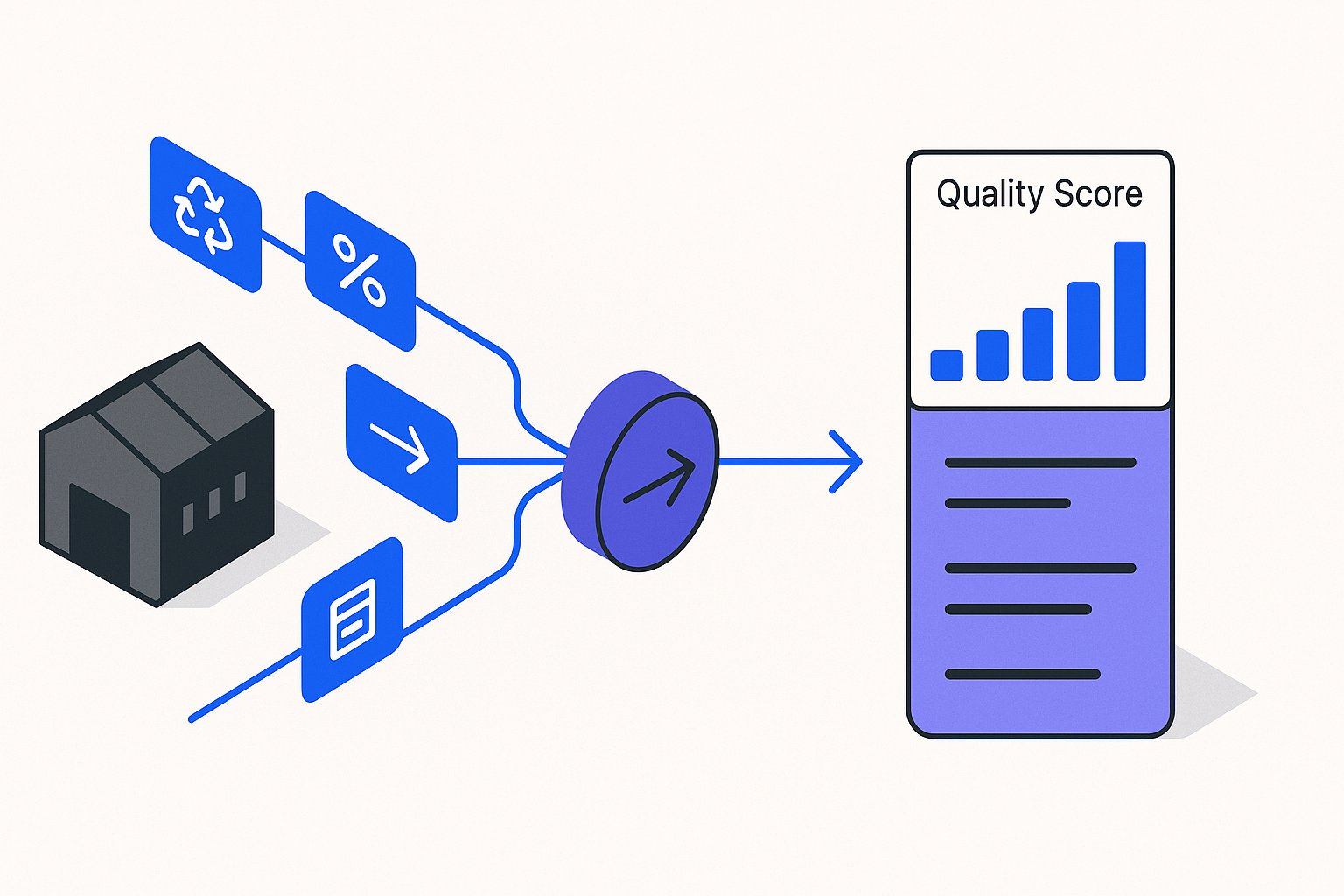
The Gap Between Shopify's Default Feed Export and What PMax Actually Wants
Shopify's native Google channel export pushes roughly 20 core attributes: title, description, price, availability, GTIN, MPN, image link, product type, and a handful of shipping fields. That covers Google's minimum requirements for approval, but PMax's asset selection engine scores products on dozens of additional signals. Google's own documentation for supplemental feed attributes (https://support.google.com/merchants/answer/6324460) lists over 60 optional fields — material, pattern, size type, age group, energy efficiency class, certification, and more. Each one narrows the auction to buyers with explicit purchase intent for that specific product dimension.
A running-shoe listing that carries size_type: wide and material: mesh doesn't just match more queries — it matches better queries where conversion probability is higher.
The practical gap is stark. In a sample audit of 40 Shopify DTC accounts we ran in Q1 2026, the median feed used 23 attributes per product. Google Shopping's top-performing products in those same verticals averaged 34 attributes. That 11-attribute delta is almost entirely filled by data already living in Shopify metafields — it just isn't being exported.
That 11-attribute delta maps almost exactly to the PMax attribute priority hierarchy we identified across 60+ audits — where material, size_type, and age_group consistently outrank every other supplemental field for ROAS lift.
PMax's impression share algorithm treats attribute completeness as a proxy for product data confidence, and products with higher confidence scores get priority placement in auto-generated asset groups.
Once your metafields are flowing correctly into the feed, the next structural decision is which SKUs belong in dedicated asset groups — high-signal metafield products typically warrant isolation from commodity SKUs to prevent budget dilution.
Google's attribute-confidence scoring is also the core mechanism behind Shopping feed Quality Score — understanding how it weights completeness versus relevance changes which metafields you prioritize first.
Why Standard Shopify App Exports Miss This
The Google & YouTube app for Shopify maps metafields to feed attributes only when you explicitly configure the mapping in the app's Feed settings → Custom data panel. Most merchants never open that panel — the default install takes title-and-price and calls it done.
Before mapping any metafields, run a structured feed audit to confirm your primary feed's 20 core attributes are error-free — enriching a feed that already has GTIN or title defects compounds disapprovals rather than fixing them.
The result is a feed that's technically compliant but commercially thin.
Which Shopify Metafields Map to Google Supplemental Feed Attributes
Not every Shopify metafield has a Google equivalent. Before you build a mapping pipeline, you need to know which fields earn you real auction signal and which are just noise.
| Shopify Metafield Namespace | Shopify Key | Example | Google Attribute | Signal Value |
|---|---|---|---|---|
| product.material | cotton_organic | material | High — filters premium/sustainable queries | |
| product.fit_type | slim , regular , wide | size_type | High — reduces wasted spend on wrong fit searches |
For apparel and footwear catalogs where size_type is highest-priority, also evaluate whether splitting Shopify variants into individual listings compounds the signal benefit — variant-level feeds can carry distinct size_type values that a single parent listing cannot.
| | shopify.sustainability_cert | GOTS , Oeko-Tex | certification | Medium-High — trust signal in apparel/home | | product.bundle_contents | 3-pack , includes charger | product_highlight | Medium — lifts CTR on bundle-specific queries | | product.age_group | adult , kids | age_group | High — required in some verticals | | custom.energy_class | A+++ | energy_efficiency_class | High — mandatory in EU for electronics | | product.care_instructions | machine washable | product_highlight | Low — copy enrichment only | | custom.internal_sku_notes | warehouse bin 4B | no equivalent | None — do not map |
Fields that have no Google attribute equivalent — internal notes, warehouse codes, ERP tags — should stay out of the feed entirely. Attempting to stuff them into custom_label fields can work, but only if you're using those labels for audience segmentation.
If you do route internal warehouse codes through custom_label fields, use a deliberate custom label segmentation framework — arbitrary label values without bidding logic attached produce no auction benefit.

How to Build a Shopify Metafield-to-Feed Mapping Pipeline
The most reliable way to surface Shopify metafields in your Google Shopping feed is through a supplemental feed in Google Merchant Center. Here is the standard three-step approach:
- Export metafields via Shopify's Storefront API or a third-party app — Tools like Littledata, Feedonomics, or a custom liquid template can pull metafield values alongside standard product data into a CSV or XML file.
Once the pipeline is live, don't assume metafield additions lift performance uniformly — a 3-cohort feed split-test isolates which specific attributes are driving ROAS change versus which are noise.
One critical detail: your supplemental feed should only carry attributes absent from the primary feed — overriding existing primary attributes with a supplemental file is the fastest route to unexpected disapprovals.
- Structure the file to match Google's supplemental feed schema — Your supplemental feed needs at minimum
id(matching your primary feed's item ID) plus whatever additional attribute columns you are adding. Use Google's exact attribute names:material,size_type,certification,age_group,energy_efficiency_class. - Upload or schedule the supplemental feed in Merchant Center — Navigate to Products → Feeds → Add supplemental feed, point it to your file URL or upload directly, then map any column headers that don't exactly match Google's attribute names using the feed rules interface.
Once the supplemental feed is processed — typically within 24 hours — those attributes merge with your primary feed at the product ID level and immediately become available to PMax's asset selection and bidding engine.
Measuring the Impression Share Lift After Metafield Enrichment
After deploying metafield-mapped supplemental feeds, track impact across three metrics in the first 30 days:
- Search Impression Share (Shopping) — A lift of 5–15% is typical when you move from 23 to 34 attributes in data-rich verticals like apparel, electronics, and home goods.
- Product-level Click-Through Rate — More specific attributes mean your listings surface in tighter, higher-intent queries. CTR improvements of 8–20% are common on products that gain
size_typeormaterialattributes. - Merchant Center Diagnostics → Feed Quality score — Check the "Missing recommended attributes" report before and after. This report directly reflects PMax's data confidence scoring and is the fastest feedback loop available.
Attribute completeness is not a one-time task. As your catalog grows and metafields evolve, build a monthly audit cadence into your feed operations to ensure new SKUs inherit the same enrichment as your top performers.
Sources & References
- Google Merchant Center Help — Official Google documentation listing all optional supplemental feed attributes (material, pattern, size_type, age_group, certification, etc.) that the article references as the 60+ fields beyond Shopify's default export.
- Google Merchant Center Help — Google's official documentation on supplemental data sources and how to use them to add or override attributes in your primary product feed, directly supporting the article's guidance on surfacing Shopify metafields as supplemental feed attributes.
- Shopify Developer Documentation — Shopify's official developer reference for metafields, supporting the article's claims about how structured product data such as material, fit type, and sustainability certifications is stored and can be accessed for feed export pipelines.
Related articles

AI Search Is Reshaping Google Shopping: Feed for SGE in 2026
Google AI shopping feed optimization now hinges on 6 feed attributes that decide which products appear in AI Overviews carousels. Fix your feed in one pass.

Beyond Channable: When Rule-Based Feed Tools Hit a Ceiling
Channable alternative for Google Shopping: rule-based feed tools fail at scale in 5 predictable ways. See the real cost and what AI rewriting fixes in under a day.

Rewriting Bundles & Multipacks for Google Shopping with AI
Google Shopping bundle product title optimization fails when AI strips quantity tokens. Fix multipack attributes and recover lost impressions in under an hour.