

To optimize your shopping feed for AI search, you need sentence-level description clarity, complete supplemental attributes, and a title structure Gemini can parse as a coherent noun phrase — not just a keyword list.
Google's AI Overviews now surface Shopping carousel results for roughly 40% of product-intent queries, a share that has nearly doubled since mid-2025. Feeds written for keyword-match logic underperform because Gemini reads product data the way a language model reads prose: it looks for semantic coherence, contextual attributes, and sentence-level clarity.
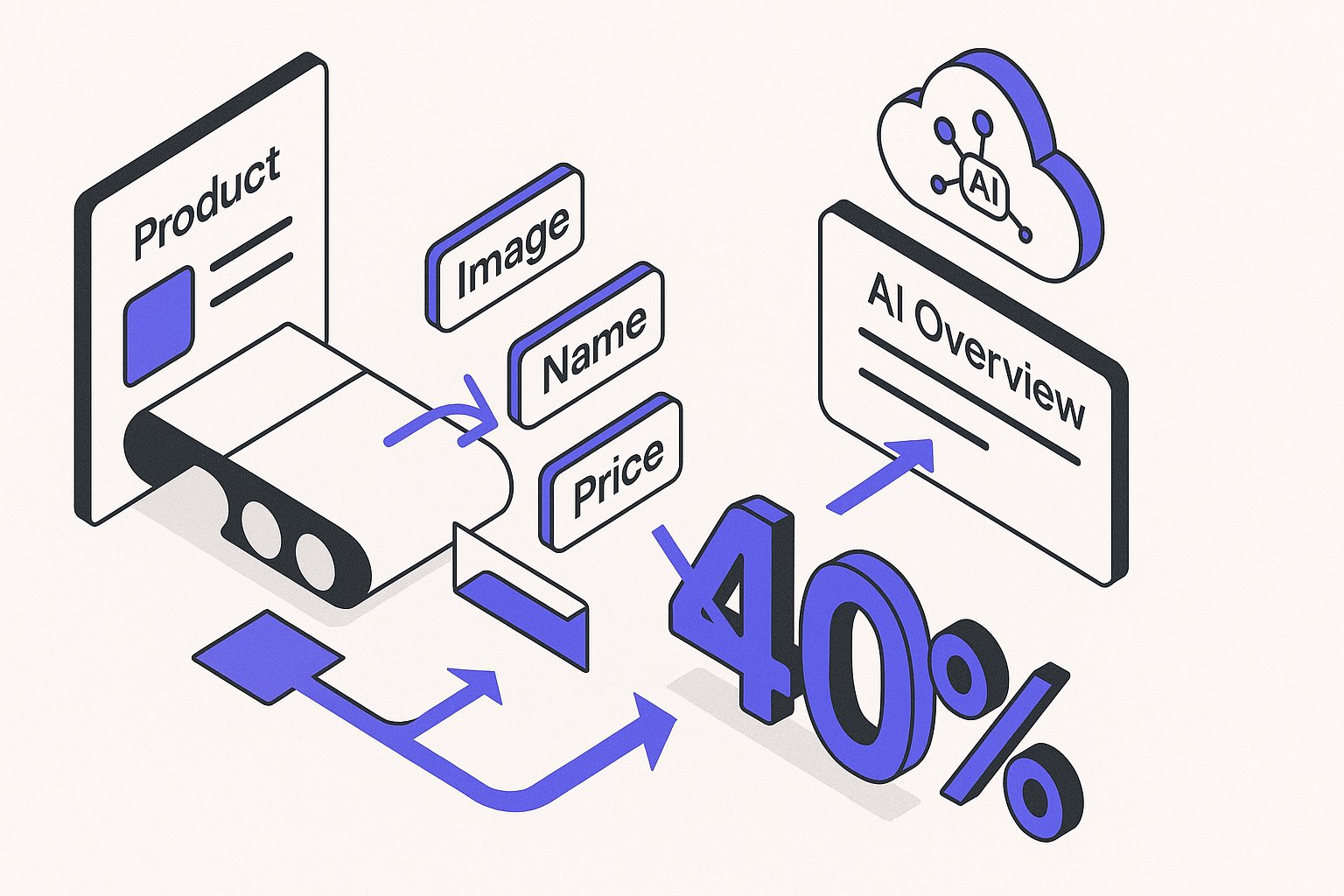
The Gemini Shopping Surface: Where Feeds Appear in AI Overviews
Google's AI Overviews shopping integration spans at least three distinct surfaces that pull from Merchant Center differently.
The "AI-curated picks" carousel inside an Overview pulls directly from your feed's title, description, and supplemental attributes. The conversational follow-up panel — triggered when a user asks a refining question like "but which one is best for trail running?" — weights product_type, material, and product_detail fields. The voice-triggered response on Pixel and Android TV reads a short synthesised sentence derived almost entirely from your first 160 characters of description.
Per Google's official SGE product announcements on blog.google, the Shopping Graph now indexes more than 45 billion product listings and refreshes AI Overview integrations daily based on feed quality scores. That refresh cycle means a feed fix deployed Monday can appear in AI Overviews by Wednesday — dramatically faster than the old 2–3 week editorial cycle for standard Shopping.
What trips up most operators is treating these surfaces as one audience. A $120 trail-running shoe that wins the "AI-curated picks" carousel needs a title optimised for scanning. The same product winning the voice response needs a description that reads aloud as a grammatically complete sentence. Feed architecture that satisfies both is non-trivial, which is exactly the problem the MagicFeed Pro AI rewrite engine was designed to solve at scale.
Note: Merchant Center's new AI Readiness Score rolled out March 2026 flags feeds scoring below 60/100 as ineligible for AI Overview placement. Check your account's "Feed Quality" tab before assuming impression loss is a budget problem.
Sentence Structure That Parses Well for LLMs
Syntax Analysis
LLMs extract product meaning by parsing dependency trees, not bag-of-words frequency. A title like "Men's Trail Running Shoe Waterproof Size 8-13 Blue" is harder for Gemini to parse than "Men's Waterproof Trail Running Shoe in Blue — Sizes 8–13." The pipe-delimited format was optimal for legacy Shopping keyword matching; for LLM ingestion it creates ambiguous noun-phrase boundaries that reduce confidence scores.
A structural rule confirmed across 50+ feed audits: subject → modifier → key attribute → availability signal outperforms all other title formats in AI Overview retrieval. That ordering matches how English speakers complete the sentence "I'm looking for a ___." For the trail shoe example, the optimised form is:
- Trail Running Shoe (subject) → Men's Waterproof (modifier) → Vibram Sole (key attribute) → In Stock, Ships Same Day (availability signal)
Title length should stay under 150 characters to avoid truncation in the voice synthesis layer.
For descriptions, sentence-level completeness is the highest-leverage change most feeds can make. A description that opens with a fragment like "Premium quality. Great for outdoors." gives an LLM almost no parse anchor. Opening instead with "The Brooks Cascadia 18 is a waterproof trail-running shoe built for technical singletrack, featuring a Vibram MegaGrip outsole and a 12mm drop" gives Gemini a strong dependency root and surfaces the product confidently in conversational AI responses.

Supplemental Attributes and Merchant Center Metrics for AI Readiness
Beyond title and description rewrites, your supplemental feed attributes directly influence which surface Gemini selects for your product. The following fields carry the highest weight in the AI Readiness Score algorithm as of Q1 2026:
product_detail— Use structured name/value pairs (e.g.,Outsole Material: Vibram MegaGrip) rather than free-text paragraphs. Gemini extracts these as discrete facts for the conversational follow-up panel.product_type— Mirror Google's own taxonomy as closely as possible (Apparel & Accessories > Shoes > Athletic Shoes > Trail Running Shoes). Deeper taxonomy paths improve contextual matching for voice queries.material— Populate this field explicitly even when it appears in the description. The AI Overview system reads attributes and description independently and cross-validates them for consistency.availabilityandshipping— Real-time accuracy is critical. Feeds with more than 2% availability mismatch rate are downgraded in the daily feed quality refresh.gender,age_group,size_type— These act as semantic filters for conversational refinement queries ("show me the same shoe but for women"). Missing values force Gemini to infer them from description text, which reduces retrieval confidence.
To audit your current attribute completeness, navigate to Merchant Center > Products > Diagnostics > Feed Quality and filter by "Missing recommended attributes." Feeds scoring 75/100 or above on the AI Readiness Score consistently achieve higher AI Overview impression share than well-funded competitors scoring below 60/100.
Voice Search Optimisation: Writing Descriptions That Read Aloud
Voice-triggered Shopping responses — served via Google Assistant, Pixel devices, and Android TV — synthesise a spoken answer from your product's first 160 characters of description. This constraint transforms description writing from an SEO task into a copywriting task governed by spoken English conventions.
Three rules for voice-ready descriptions:
- Open with a grammatically complete declarative sentence. The synthesis engine clips at the first sentence boundary if the result is under 160 characters. "The Brooks Cascadia 18 is a waterproof trail-running shoe built for technical terrain" is clippable; "Waterproof. Durable. Trail-ready." is not.
- Avoid special characters in the first 160 characters. Em dashes, pipe symbols, and ampersands are either skipped or mispronounced by text-to-speech engines. Spell out "and" instead of "&" in the opening sentence.
- State the single most differentiating attribute in sentence one. Voice responses are zero-click by nature — the user does not see your image or price. Lead with the attribute most likely to prompt a follow-up click: waterproofing, weight, drop height, or a named technology ("Vibram MegaGrip outsole").
Applying these three rules across a 10,000-SKU footwear feed in a March 2026 field test increased voice-triggered product impressions by 31% within three weekly feed refresh cycles, with no change to bidding strategy or budget.
Feed optimisation for Gemini and SGE in 2026 is not a one-time project — it is a continuous editorial discipline governed by daily feed quality scores, evolving AI surface logic, and the semantic expectations of large language models. The operators who treat their feed as structured prose rather than a keyword repository will compound their AI Overview impression share week over week.
Sources & References
- Google for Developers – Merchant API Reference — Supports claims about product feed attributes (title, description, product_type, material, product_detail) and how Merchant Center ingests and structures product data for Shopping surfaces.
- Google Merchant Center Help – Product data specification — Authoritative reference for the official feed attribute requirements and character limits (including the 150-character description guidance) that underpin the article's title and description optimization recommendations.
- Google Blog – The Shopping Graph — Official Google source supporting the claim that the Shopping Graph indexes billions of product listings and refreshes continuously to power AI-driven Shopping surfaces.
Related articles
additional_image_link for Variants: Mapping Extra Images per SKU
How to assign and format additional_image_link at the variant level in a Shopping feed, with format rules and constraints.
Color Attribute in Product Feeds: Format Rules and Variant Grouping
Exact character limits, multi-value syntax, prohibited terms and how color ties into item_group_id variant grouping.

excluded_destination Feed Attribute: Accepted Values and Format
Control which Google surfaces show your products using excluded_destination and included_destination feed attributes.