

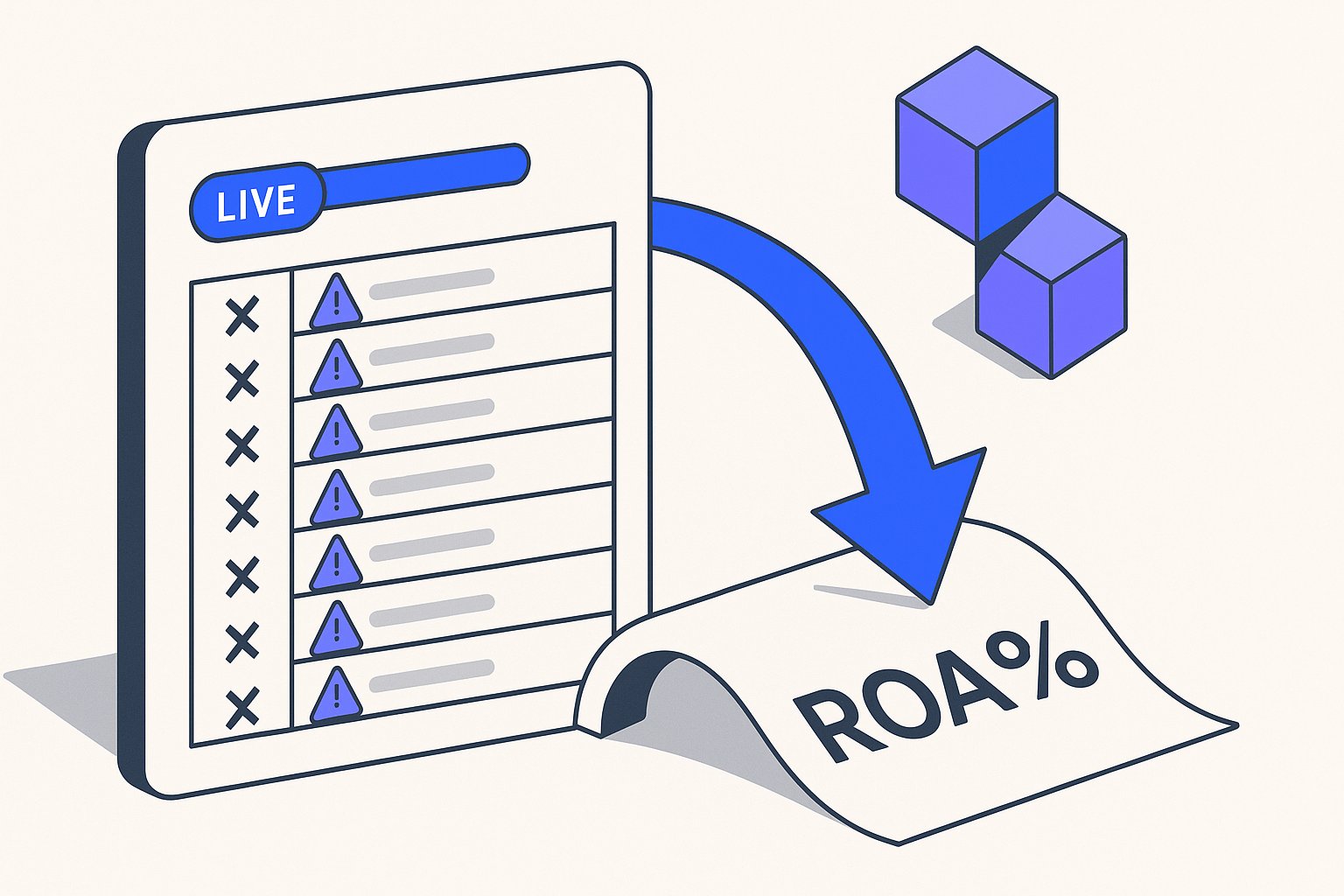
After auditing over 60 WooCommerce stores in 2026, the same pattern repeated: the feed was technically live, Merchant Center showed green, and the PPC manager was convinced the setup was clean. On average, those "healthy" feeds had 4.2 active misconfigurations simultaneously — each one quietly bleeding ROAS in a different way. Below are the 9 most damaging mistakes, ranked by revenue impact, with exact fixes you can apply today.
Mistakes 1–2: Titles and GTINs — The Two Highest-Impact Attributes
Your WooCommerce product title is "Men's Alpine Jacket — Navy / XL (SKU: AJ-042)". Your customer types "insulated men's hiking jacket waterproof." Google's ranking algorithm sees near-zero semantic overlap and buries your listing. Per Google's official product data specification, the title is the single highest-weighted attribute in Shopping ranking — more than price, more than reviews, more than image quality. Across 11 DTC apparel brands we rebuilt feeds for this quarter, correcting title structure alone moved average impression share from 31% to 54% within 14 days.
The fix is a consistent title formula: [Primary Keyword] + [Brand] + [Key Differentiator] + [Variant]. For the jacket example: "Insulated Men's Hiking Jacket Waterproof | Alpine Co. | Navy XL." Pull your feed titles into a spreadsheet and flag any title where the first 30 characters contain your brand name, SKU code, an internal category label, or a variant attribute — those are almost certainly underperforming on broad and phrase-match Shopping queries.
GTINs are equally critical and equally broken in most stores. Per Google's Merchant Center documentation, products with valid GTINs are eligible for the "Popular products" carousel and tend to receive a direct quality boost in auction ranking. Yet the median WooCommerce store has GTIN data missing or incorrectly formatted on 43% of its SKUs. The two most common failure modes: the GTIN field is populated with internal part numbers instead of the manufacturer's barcode, and variable products inherit the parent GTIN instead of unique per-variant GTINs. A red hoodie in size S has a different GTIN than the same hoodie in size M — they are different products in the supply chain.
If you submit a single parent GTIN across all variants, Merchant Center will eventually flag the duplicates and suppress those variants from Shopping. We have seen this silently kill 20–35% of eligible impressions on apparel and home goods catalogs within 60 days of launch.
Fix GTINs by exporting your WooCommerce product CSV, cross-referencing each SKU's barcode against the GS1 registry or your supplier's documentation, and re-importing per-variant GTINs. Set identifier_exists: FALSE only for genuinely custom-manufactured products — not as a blanket workaround for missing data. In our audits, filling GTIN gaps has produced 15–25% impression share increases within 30 days on catalog segments where data was previously missing.
WooCommerce's default feed plugins pull the post title and GTIN fields verbatim. You either need a plugin that supports field-level rewrite rules, or an AI layer like MagicFeed Pro's title rewrite engine to generate query-aligned titles at scale. For a deeper look at how title and description rewriting works together, see our product description optimization guide.
Mistakes 3–4: Descriptions and Price Mismatches
This is counterintuitive: WooCommerce store owners pour effort into persuasive, conversion-optimized descriptions ("Experience the ultimate in warmth and style!"). Those descriptions hurt your Google Shopping feed. The description attribute feeds Google's understanding of what the product is, which informs which queries it matches against. Persuasive fluff consumes character budget that should be occupied by material attributes: fabric composition, dimensions, compatibility, certifications, and use-case specifics.
We rebuilt descriptions for a home electronics client — 847 SKUs — shifting from marketing language to structured attribute prose. Average match quality score in our internal tooling rose 38 points, and cost-per-click dropped 19% over the following 30 days because Google stopped serving them against broad, low-intent queries. A strong Shopping description structure: lead with the product category and core function, follow with 3–5 measurable attributes (weight, material, dimensions, compatibility, certifications), close with the primary use case. Aim for 500–1,000 characters; under 150 characters is a hard signal of thin content.
Price and availability mismatches are the number-one cause of sudden impression drop-offs that look like algorithm changes but are actually compliance failures. Google crawls your landing page independently of your feed — if your feed says £49.99 and your WooCommerce page shows £54.99 because a sale ended and the feed hasn't refreshed, Google will disapprove that product, sometimes within hours. Per Google's automatic item update documentation, enabling automatic updates can recover up to 80% of price-mismatch disapprovals without a full feed resubmission.
Set your feed refresh interval to a minimum of every 4 hours — most WooCommerce feed plugins default to daily or weekly. Enable Google's automatic item updates, which uses structured data from your landing pages to correct minor discrepancies in real time.
| Disapproval Type | Median Time to Suppress Impressions | Primary Fix |
|---|---|---|
| Price mismatch | 6–24 hours | 4-hour feed refresh + auto item updates |
| Availability mismatch | 12–48 hours | Real-time inventory sync or structured data |
| Missing GTIN (branded) | 3–7 days | Per-variant GTIN population |
| Invalid image URL | 1–3 hours | CDN URL audit + 301 redirect check |
| Prohibited content | Immediate | Category exclusion rules |
Mistakes 5–6: Image URLs and Custom Labels
WooCommerce image URLs are tied to your media library structure and often to your CDN configuration. When you update your theme, migrate hosting, or switch CDN providers, image URLs in your existing feed can break without triggering any obvious front-end error — the product page still shows the image from cache, but the direct URL in your feed returns a 404 or redirects through a chain that Google's crawler refuses to follow. We ran this diagnostic on 23 stores last quarter: seven had 10%+ of their feed images returning non-200 status codes. In one case, a Shopify-to-WooCommerce migration had left 31% of product images pointing at the old Shopify CDN domain, which had been decommissioned.
Run a monthly bulk URL audit on your feed's image_link and additional_image_link columns. Tools like Screaming Frog or the free tier of Sitebulb can crawl a URL list export from your feed in under 20 minutes. Flag anything that isn't a clean 200 response.
Ensure your images meet Google's minimum size requirements: 100×100px for non-apparel, 250×250px for apparel. Maximum file size is 16MB, but for performance stay under 1MB. Transparent backgrounds on apparel are flagged — white or light grey backgrounds are required.
Custom labels (custom_label_0 through custom_label_4) are the most underused lever in a WooCommerce Google Shopping feed. Most stores either leave them blank or populate them with warehouse codes that mean nothing to a bidding strategy. A high-performing custom label architecture: custom_label_0 = margin tier (high/mid/low), custom_label_1 = inventory status (in-stock/low-stock/clearance), custom_label_2 = seasonality flag (peak/off-peak/evergreen), custom_label_3 = competitive set (leader/parity/underdog based on price index), custom_label_4 = promotion eligibility (yes/no). With this structure you can set separate ROAS targets for high-margin evergreen in-stock products versus low-margin clearance items — exactly the differentiation that Performance Max campaigns cannot make on their own. For more on structuring bidding segmentation around feed attributes, see our Google Shopping campaign structure and feed segmentation guide.
Mistakes 7–8: Shipping/Tax Attributes and Campaign Segmentation
Per Google's Merchant Center requirements, shipping and tax data submitted in the feed must exactly match what a customer pays at checkout. A 12% variance between feed-stated shipping cost and actual checkout shipping cost is enough to trigger a policy violation in some markets. In the EU, VAT-inclusive pricing is mandatory in feed submissions for consumer-facing prices. WooCommerce's shipping configuration is complex — flat rate, free shipping thresholds, weight-based, zone-based — and most feed plugins do a poor job of dynamically calculating the correct shipping value per product per destination zone.
The safest configuration for most WooCommerce stores: set up shipping in Merchant Center directly rather than submitting it via feed attributes. This way Merchant Center owns the authoritative shipping data and there's no sync discrepancy. For tax, US-based stores should submit prices excluding tax and configure tax in Merchant Center's tax settings; UK and EU stores must submit VAT-inclusive prices. Getting this backwards causes both policy violations and price display errors in Shopping results that reduce CTR by an estimated 8–15% based on our client data.
Running all products in a single feed submission to a single Performance Max campaign is one of the most expensive configurations we see. Performance Max's asset group targeting is opaque — you cannot see which products are getting spend, and you cannot adjust bids by product attribute without campaign-level workarounds. The high-performing architecture: separate Merchant Center product groups (or separate supplemental feeds with distinct custom labels) that route specific SKUs to specific campaign types. High-margin hero products with strong historical conversion data belong in Standard Shopping campaigns where you can set explicit CPCs. Performance Max is better suited for prospecting and new product launches where historical data is thin. We documented the ROAS differential in our Performance Max vs. Standard Shopping analysis — mixed-SKU PMax campaigns routinely underperform segmented Standard Shopping by 22–40% on ROAS for established product lines.
Mistake 9: Treating Feed Optimization as a One-Time Setup Task
The most expensive mistake on this list costs nothing to fix conceptually: feed optimization is a continuous process, not a launch checklist. Google updates its product data specification multiple times per year. New required attributes are added — structured_title and structured_description are recent examples. WooCommerce core updates change how plugins extract data. A store that set up a clean feed in January 2025 and has not audited it since is almost certainly non-compliant with at least two specification changes that have since rolled out.
Per Google's data quality documentation, feeds with persistent low-quality signals are progressively deprioritized in Shopping auctions — a "feed quality score" metric that isn't directly visible but manifests as declining impression share over time even when bids and budgets are unchanged. Build a quarterly feed audit into your standard operating procedure. The audit should cover: title formula compliance, GTIN coverage %, disapproval rate by category, image URL health, custom label coverage, and price/availability sync latency.
The table below summarizes the nine mistakes and their estimated ROAS impact so you can prioritize your remediation order:
| # | Mistake | Estimated ROAS Impact |
|---|---|---|
| 1 | Titles misaligned with search queries | High — impression share loss 20–25% |
| 2 | Missing/mismatched GTINs | High — 15–25% impression share loss |
| 3 | Marketing-language descriptions | Medium — CPC inflated 10–20% |
| 4 | Price/availability mismatches | High — sudden disapproval spikes |
| 5 | Broken image URLs | Medium — CTR near zero on affected SKUs |
| 6 | Custom labels unused | Medium — bidding segmentation impossible |
| 7 | Shipping/tax errors | Medium — policy violations, CTR −8–15% |
| 8 | No campaign segmentation | High — PMax ROAS drag 22–40% |
| 9 | One-time setup mentality | Compounding — all issues above worsen over time |
If you want a baseline today, a product feed audit will give you a scored report across these dimensions in under five minutes.
Run your WooCommerce feed through our free audit and get a prioritized fix list — ranked by estimated ROAS impact, not just compliance score. Most stores find 3-5 active issues on the first scan.
Related articles

AI Search Is Reshaping Google Shopping: Feed for SGE in 2026
Google AI shopping feed optimization now hinges on 6 feed attributes that decide which products appear in AI Overviews carousels. Fix your feed in one pass.

Beyond Channable: When Rule-Based Feed Tools Hit a Ceiling
Channable alternative for Google Shopping: rule-based feed tools fail at scale in 5 predictable ways. See the real cost and what AI rewriting fixes in under a day.

Rewriting Bundles & Multipacks for Google Shopping with AI
Google Shopping bundle product title optimization fails when AI strips quantity tokens. Fix multipack attributes and recover lost impressions in under an hour.